

Corporate Holiday Party in Provo: How Do You Get Employees Who Normally Skip It to Attend?
Your corporate holiday party in Provo has the same guest list problem every December. Half the invite list replies yes. The same faces show up, the same faces stay home, and the planning committee spends November guessing why. The people who skip are not antisocial. They weigh what the party costs them in time, money, and comfort, then decide the trade is bad. Every one of those costs sits inside a decision your committee already controls: the date, the hour, the guest policy, the menu, and the building. Fix the costs and attendance follows. The numbers below come from one Utah County venue.
TL;DR
Employees skip holiday parties because the party takes personal time, costs them money, or puts them on the spot. Move the party into work hours, drop mandatory attendance, open plus-ones to any guest, feed everyone equally, and pick a venue with easy parking and step-free access. Attendance rises when the party stops costing people something.
Table of contents
Why do employees skip the company holiday party?
When should you schedule a holiday party so more people show up?
How do you make attendance optional and still fill the room?
What food and drink choices bring reluctant employees back?
How do you replace forced fun with something people enjoy?
What venue details decide whether people come or leave early?
What should a Provo company budget for a party people want to attend?
Frequently asked questions
Why do employees skip the company holiday party?
Employees skip the holiday party when attending costs them something they value more than the event. The four common costs are personal time on an evening or weekend, out-of-pocket ticket or potluck fees, social exposure through forced games, and a long drive to a venue with no parking. Remove the cost and the objection disappears.
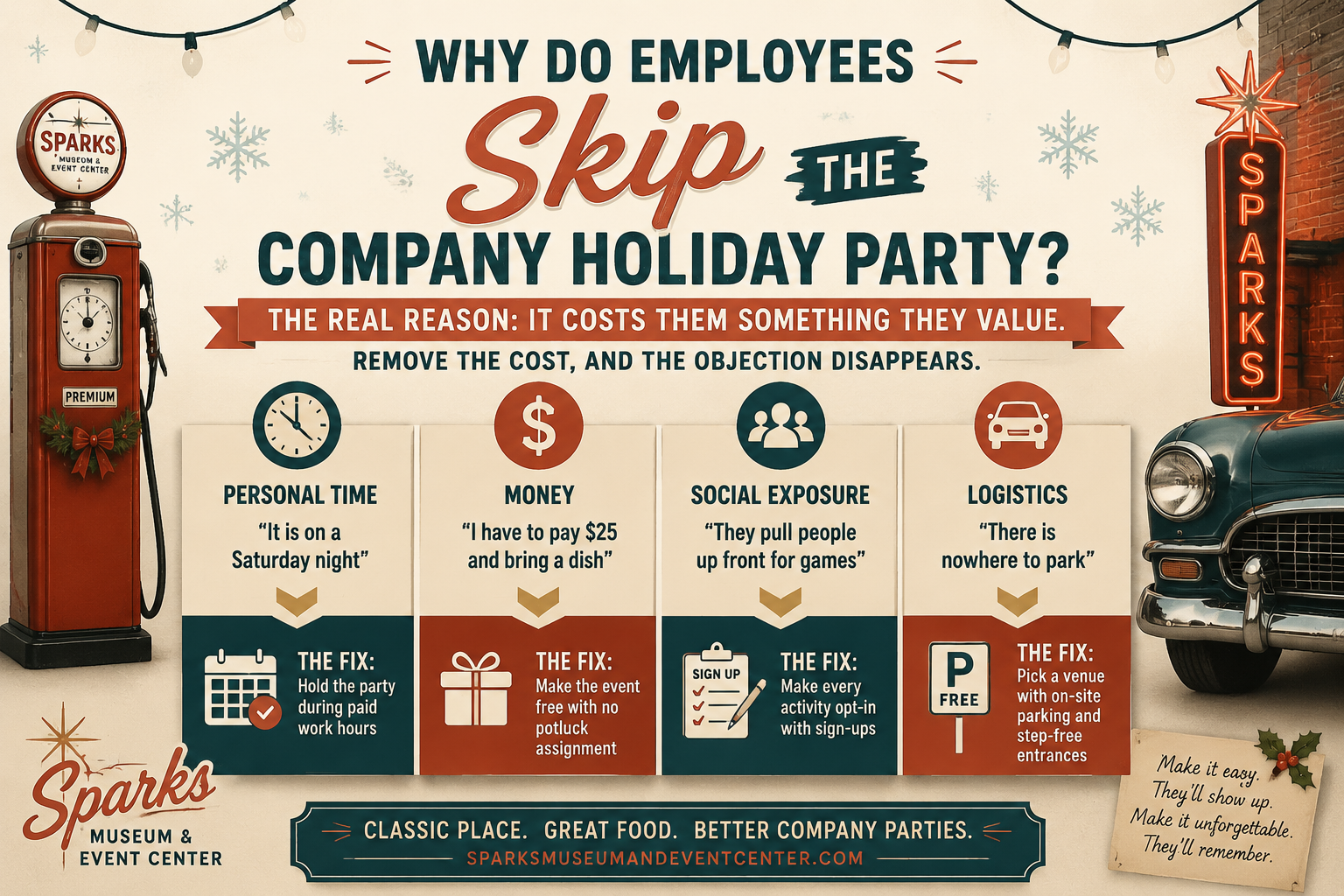
The Four Core Reasons Employees Skip Holiday Parties and The Fix.
Ask a Manager collected hundreds of first-hand accounts from employees on this question. One employee summarized the time objection in a single line: "I spend so much time away from my kid as it is, I'm not giving up more family time." December already carries school concerts, family travel, and church programs across Utah County. An evening party competes with all of it and loses.
Money is the second objection, and it surprises planners. Employees in those accounts reported paying $20 to $35 to attend a work function. One wrote, "I would never ever ever go to a work party I had to pay for." Potluck assignments work the same way. A required dish is a fee with extra steps.
Social exposure ranks third. Surprise contestants, mandatory sing-alongs, and tied-on noisemaker games read as fun to the committee and as an ambush to the person pulled up front. A CEO speech turns the party back into a meeting.
The fourth objection is logistics. A venue on the far side of the valley with street-only parking turns a soft yes into a no.
When should you schedule a holiday party so more people show up?
Schedule the party inside paid work hours. A weekday afternoon block costs employees nothing in personal time, which removes the largest single objection. If the party has to run in the evening, give the afternoon off in exchange, hold it midweek instead of Friday, and publish a hard end time so people leave without guilt.
Ask a Manager's readers named a 3:00 to 5:00 p.m. Friday block as the format they liked best, because it let them start the weekend early rather than surrender a night. The same readers flagged 7:00 p.m. Saturday parties as the worst version, since attending meant driving back to work territory on a day off.
Utah County venues support the daytime version. Sparks Museum and Event Center in Provo books weekday daytime events from 9:00 a.m. to midnight, so a 2:00 to 6:00 p.m. corporate block sits inside standard availability rather than a special request. The weekday rate at Sparks runs $400 per hour against a standard range of $400 to $650, so moving the party off Saturday lowers the venue line at the same time it lowers the personal cost to your team.
Calendar pressure is real. December dates at Sparks book about three months ahead, and December weekend dates fill first. Committees planning in September should treat weekday afternoons as the realistic option, not the fallback.
Evening events need a published stop. Friday and Saturday events at Sparks end at 11:00 p.m., with amplified music off by the same hour. Build the last song and the closing announcement into the run sheet.
How do you make attendance optional and still fill the room?
State plainly that attendance is optional and that nobody tracks who comes. Then remove the reasons to decline. Open plus-ones to any guest rather than spouses only, publish a two to three hour window with a real end time, and make sure nobody who stays behind gets stuck covering the office alone.
Optional means optional in practice, not only in the invitation. Ask a Manager's guidance is direct on this point: you cannot penalize people who decide not to attend, even unofficially. Readers described managers who gave grief to employees who declined, and one who was assigned to staff the office while coworkers went to the party. Both patterns poison next year's attendance more than one bad party does.
Guest policy carries more weight than most committees expect. Limiting plus-ones to spouses tells single employees the party was designed around someone else. Opening the invitation to a partner, a friend, or a roommate costs the same per head and reads as inclusion.
A defined window does quiet work. Readers praised parties with a clear two to three hour block because leaving at the end felt normal instead of rude. Sparks carries a four-hour rental minimum with setup and teardown counted inside those hours, so a committee reserving four hours runs a two-hour party with a full hour on each side for load-in and cleanup.
Scale matters less than you think. Sparks hosts smaller evening events with a 15 to 20 guest minimum and no minimum spend, so a 30-person company gets the same terms as a 300-person one.
What food and drink choices bring reluctant employees back?

Corporate holiday party planning checklist with venue floor plan and catering quote.
Serve food everyone eats. Ask about dietary needs before you order, then build vegetarian, gluten-free, and other alternatives into the main menu rather than adding a side salad. Keep the event free to attend. If you serve alcohol, hire a licensed bartender and put non-alcoholic options at the same table.
Food is the largest line on the budget. Playtyme's office holiday party budget breakdown puts catering at 40 to 50 percent of total spend, with buffet service at $30 to $55 per person, passed appetizers at $15 to $25, plated dinners at $50 to $100 and up, and drink packages at $15 to $35.
The complaint employees repeat is exclusion by menu. One described "picking through a sad, wilted green salad while everyone else tucks into a lavish meal." A vegetarian entree ordered in the same quantity as the others fixes that for the price of a phone call.
Venue policy decides how much room you have. Sparks maintains a preferred caterer list including Marvelous Catering, Magleby's, Brown Brothers Catering, LUX Catering and Events, and Market Catering, and clients bring in any outside licensed caterer instead if they prefer. The on-site kitchen warms and plates food brought in from a caterer or a restaurant order, and it plates up to 500 guests per service window using a single range and stove. The kitchen works as a prep and warming area, so the client arranges hot delivery with the caterer.
Alcohol carries a rule set. Sparks allows beer and wine with a licensed bartender, and the client hires that bartender service directly. Non-alcoholic service runs the same way. A beverage or bar service supplies all the drinks, and the cost shifts with the type of drink, from plain sodas up to slushies and ice cream based drinks. Order the non-alcoholic side at the same volume as the beer and wine. A staffed drink station signals the party was built for everyone.
How do you replace forced fun with something people enjoy?
Replace mandatory activities with things people opt into. Give the room something worth walking around and photographing, keep games in a side area with explicit sign-ups, cap prizes low, and cut the business content entirely. Adults attend parties for conversation and food. Structure the evening to protect both.
The failure mode is well documented. Ask a Manager readers described magicians, balloon animals, tied-on bells shaken out in front of coworkers, and mandatory Christmas carols. The common thread is participation without consent. The same readers supported optional games run in a separate area with prizes under $10 and explicit opt-in, so the objection targets the pressure rather than the game.
Atmosphere solves the problem better than programming. Sparks Museum and Event Center is built around an authentic American petroliana collection with antique gas pumps, vintage signs, and rotating classic car displays. Event guests tour the collection during a rental on a self-guided basis, photography is welcome throughout, and the only rule is no touching the marked or roped vehicles. A room people wander and photograph produces the mingling a forced icebreaker tries to manufacture.
The technical side supports a light program. On-site AV at Sparks includes eight wall speakers, two wireless handheld microphones, a six-zone Bluetooth audio system, and two large-screen televisions, all included in the hourly rate. House lighting runs by zone, and the neon signs stay on or off at the client's request. The open floor holds a dance area for up to 600 dancers without tables.
Outside entertainment runs $500 to $1,500 for a DJ, $400 to $1,200 for a photo booth, and $1,500 to $4,000 for a live band, per Playtyme's benchmarks. [FACT NEEDED: preferred entertainment vendor names]
What venue details decide whether people come or leave early?
Parking, drive time, step-free access, transportation, and winter comfort decide attendance more often than the theme does. Employees decline invitations to venues with no parking, a long commute, or stairs at the door. Confirm all five before you sign, and publish the parking, drop-off, and access details in the invitation.
Ask a Manager readers listed the logistics failures precisely: one-hour commutes to a main office venue, $50 rideshare fares from a suburban location, and venues no transit line serves. The guidance is simple: pick a location employees reach easily.
Numbers make this checkable. Sparks offers 80 on-site parking spaces with overflow street parking nearby, sits 4.6 miles from central Orem at roughly 15 minutes by car, and sits 2.2 miles from BYU campus at about 10 minutes. For a company drawing staff from Orem, Lehi, and Springville, those drive times keep the invitation realistic.
Access gets noticed in December. Sparks provides single-level event access with three step-free entrances, one at the east front next to accessible parking and one on the north side. Restrooms include an accessible stall with turning clearance and wide door width, located 20 to 50 feet from the main floor. Tell the venue about accessibility needs in advance so staff prepare the space properly.
Transportation is the fix for employees who do not drive or who plan to drink. Sparks designates 4134 W Center Street as the drop-off and pickup point for shuttles and rideshare, and the client arranges the transportation itself. Put the address and pickup window in the invitation. [FACT NEEDED: on-site parking for buses and shuttles]
Winter comfort is the quiet one. The 5,000 square foot floor at Sparks stays temperature controlled and warmed through December events using in-house heating. Coat handling needs a plan, since the venue has no dedicated coat check and instead offers a separate private room where coats sit out of the guest flow.
What should a Provo company budget for a party people want to attend?
Budget per person, then allocate by category. National benchmarks put a budget-tier holiday party at $40 to $75 per person, a mid tier at $75 to $150, and a premium tier at $150 to $200 and up. Venue rental takes roughly 20 percent of the total. Start planning eight to ten weeks out.
Playtyme's category split gives a working frame. Utah County venue costs run below the tri-state figures in that source, so build the venue line from local quotes.

What is the percentage of how much you should really spend on a holiday party in Provo, Utah?
Local numbers anchor the venue line. Sparks charges $400 to $650 per hour set by day of week and season, with weekends and holidays at the top of the range. Weekday bookings run $400 per hour, and non-profit rates are set case by case. There is no seasonal holiday package at Sparks, so the standard hourly rate applies to December corporate parties.
Included items reduce spending elsewhere. A Sparks rental covers up to 30 six-foot round tables and 240 chairs at no extra charge, plus AV and lighting. Venue staff set up tables and chairs, and the client strikes them at the end unless the committee arranges otherwise, which holds staffing cost down. Submit the floor layout at least seven days out, since later changes trigger a $250 reset fee and no reset happens inside four hours of start time.
Two charges belong in the contingency line. Confetti, tape, or adhesive requiring staff cleanup adds a $125 fee. Open flames, indoor fireworks, and combustible items are not permitted, which rules out candle centerpieces near the collection.
Frequently asked questions
What is the single most effective change to raise holiday party attendance?
Move the party into paid work hours. Employees skip evening and weekend parties because those events take personal time during the busiest month of the year. A weekday afternoon block removes that cost entirely and typically raises turnout more than any menu, theme, or entertainment upgrade.
Should employees be allowed to bring a guest to the company holiday party?
Yes, and the invitation should not limit guests to spouses. Restricting plus-ones to spouses signals to single employees that the event was planned around someone else. Opening the invitation to a partner, friend, or roommate costs the same per head and improves attendance among the group most likely to decline.
How long should a corporate holiday party run?
Two to three hours with a published start and end time. A defined window lets people leave at the end without feeling rude. Sparks Museum and Event Center in Provo carries a four-hour rental minimum with setup and teardown included, which fits a two-hour party plus an hour on each side.
How far in advance should a Provo company book a December holiday party?
Three months. December dates at Sparks Museum and Event Center book roughly three months ahead, and December weekend dates fill first. Companies planning a weekday afternoon party have more flexibility, but committees should still confirm the date by early October.
Does a holiday party need alcohol to draw a crowd?
No. Alcohol appeals to part of a workforce and gives another part a reason to skip. At Sparks, beer and wine require a licensed bartender the client hires directly, and a beverage service supplies non-alcoholic drinks priced by type, from sodas to slushies. Free food, an easy location, and optional attendance drive turnout more reliably.
What does a corporate holiday party cost per person?
National benchmarks run $40 to $75 per person at the budget tier, $75 to $150 at the mid tier, and $150 to $200 and up at the premium tier. Catering takes 40 to 50 percent of that total, and venue rental takes about 20 percent.
Plan the party your team actually attends
Attendance is an outcome of decisions, not of enthusiasm. Companies across Utah County fill the room by scheduling inside work hours, keeping attendance optional, opening plus-ones to any guest, feeding everyone equally, and choosing a building with parking, step-free entrances, and heat in December. None of those choices require a bigger budget. Most of them lower it.
Walk your committee through the venue before you commit. Look at the parking count, the entrances, the floor, and the collection your team will spend the evening walking through. Book a free venue tour at Sparks Museum and Event Center in Provo and see the space for yourself. December weekend dates fill first, so check your date at the Provo event venue before your planning meeting.
Check out some other venues across the country that pride themselves in supporting one another.