

How Soon After Death Should You Hold a Celebration of Life?
TL;DR
Most families hold a celebration of life between two weeks and three months after the death. Nothing requires you to wait, and nothing requires you to rush. Your date depends on three things: when out-of-town family can travel, when the venue has space, and when you are ready to stand in a room full of people.
You are making decisions you never wanted to make, on a timeline nobody explained to you. Somewhere between the phone calls and the paperwork, someone asks when the celebration of life will be. You do not have an answer. You are not sure there is a right one.
There is no legal deadline and no required waiting period. A celebration of life is not a funeral, and it does not follow funeral rules. That freedom is the point, and it is also what makes the question hard. This guide gives you the ranges most families land on, the three things that actually control your date, and what changes when you move fast versus when you wait. The venue details come from Sparks Museum and Event Center in Provo, Utah, where families book these gatherings on every timeline, from two days out to a full year later.
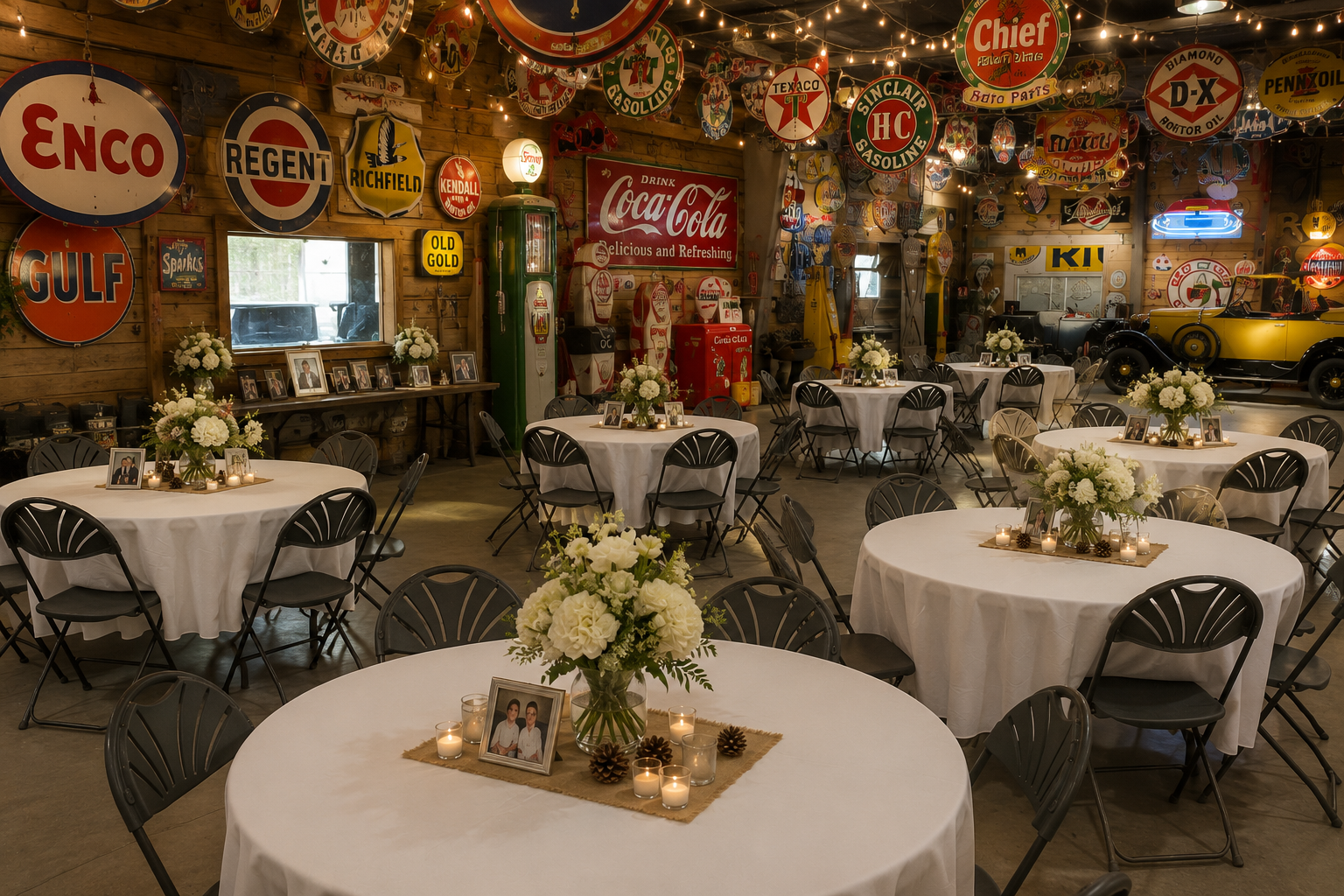
Event hall set for a celebration of life with round tables and a memorial photo display
What this guide covers
How soon after death should you hold a celebration of life?
How does celebration of life timing differ from funeral timing?
Is three months too long to wait?
What has to happen before you can set a date?
How quickly can you book a venue if you need to move fast?
How does your date change cost, attendance, and logistics?
Frequently asked questions
How soon after death should you hold a celebration of life?
Most families hold a celebration of life between two weeks and three months after the death. Published planning guidance clusters in that window, with two to eight weeks cited most often and two to three months common when family travels from out of state. No law, religion, or industry standard sets a deadline. You choose the date.
That range exists for a practical reason. Two weeks is roughly the earliest point at which you can notify a wide circle of people, let them arrange travel, and plan a gathering without doing it inside the first shock of loss. Three months is roughly the outer edge before momentum fades and attendance drops.
Inside that window, the decision is yours alone. Families who need the event to happen quickly hold it within days. Families waiting on a sibling deployed overseas hold it in the spring. Both are correct. The date serves the people who loved the person, and nobody outside that circle gets a vote.
If you are reading this ten days after a death and wondering whether you are behind, you are not. Ten days in, most families have not chosen a date yet.
How does celebration of life timing differ from funeral timing?
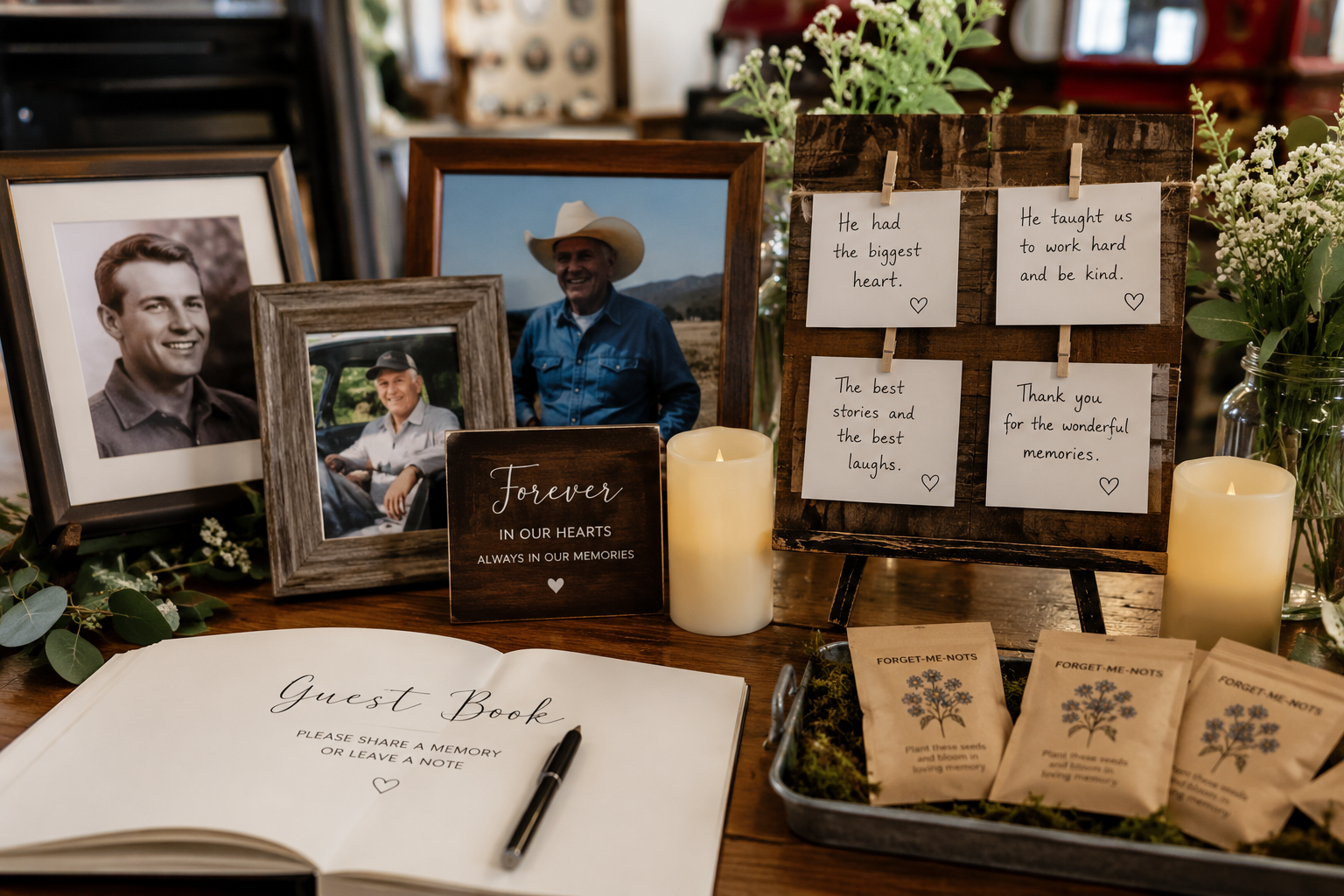
Memory table with framed photographs and a guest book at a celebration of life
Funerals run on a short clock because the body is present. Published guidance places most funeral services within three to seven days of death. A celebration of life carries no such constraint, because it usually happens after burial or cremation is complete. AARP's memorial planning guidance draws this same distinction: funeral services follow soon after a death, while a memorial service can be held at any time and in any place.
This is the single most useful fact in the whole decision. The two events are not competing for the same date, and many families hold both.
A common Utah County sequence looks like this. The funeral or graveside service happens within the first week, often at a church or mortuary, arranged largely by the funeral home. The celebration of life happens weeks later at a venue the family chooses, with a program the family writes, food the family picks, and space for people to actually talk to each other.
Separating the two lowers the pressure on both. The funeral handles the ritual. The celebration handles the memory. Neither has to carry the whole weight.
Is three months too long to wait?
Three months is not too long. It is inside the range most families use, and it is the most common choice for families coordinating travel across several states. The real risk is not waiting too long. The real risk is waiting without a date on the calendar.
An announced date does work that an open-ended intention cannot. It tells people when to request time off. It gives you a deadline for gathering photos. It gives the family something to move toward during the weeks when nothing else has structure.
Past roughly six months, attendance usually thins. People who would have come at eight weeks have absorbed the loss privately and moved on. That does not make a six-month or one-year gathering wrong. Anniversary celebrations are a real and meaningful format. Just know you are choosing a smaller, closer gathering rather than a wide one.
Set a date before you are certain about the details. You can adjust a program. You cannot recover the momentum you lose in an undecided month.
What has to happen before you can set a date?
Three things gate your date, and only three. Everything else is a detail you settle afterward.
First, disposition. Burial or cremation usually happens before the celebration of life, so confirm that timeline with the funeral home before you promise anyone a date.
Second, the people who must be there. Make a short list of the ten to fifteen people whose absence would change the event. Call them before you book anything. Out-of-state family needs three to four weeks to arrange affordable travel, and a date that works for the venue but not for the person's sister is the wrong date.
Third, venue availability. Weekend dates go first and stay gone. At Sparks Museum and Event Center in Provo, Friday and Saturday rates run $400 to $500 an hour, compared with $300 to $400 Monday through Thursday, and weekend dates book before weekday dates do. A Thursday afternoon in three weeks is frequently open when the next four Saturdays are not.
Once those three line up, everything downstream is adjustable. Caterer, program order, photo displays, music. Those follow the date. They do not set it.
How quickly can you book a venue if you need to move fast?
Faster than most families expect. Sparks books events with as little as 48 hours notice, with short-notice availability depending on the existing calendar. Families arriving from out of state on a compressed schedule, or families who decided late to gather after the funeral, are not out of options.
Short-notice bookings work because the logistics are simpler than a wedding. Our rental carries a 3-hour minimum with setup and teardown included in those hours, so a two-hour gathering with a half hour on each side fits the minimum without extra charges. A $750 deposit reserves the date, and the balance comes due one week before the event.
The pieces that take real lead time are catering and printed materials, not the room. Our preferred caterers include Marvelous Catering, Magleby's, Brown Brothers Catering, LUX Catering and Events, and Market Catering, and you are welcome to bring any licensed caterer you prefer. Popular caterers book early, so call them the same day you reserve the venue.
Plan the photo display around what the venue supplies. Sparks provides tables for photo and memory displays in 8-foot and 6-foot lengths, plus 6-foot and 3-foot rounds. We do not provide easels, stands, or display cases, so bring those or plan a flat-table layout.
How does your date change cost, attendance, and logistics?

Calendar with a chosen date for a celebration of life gathering
Your date moves three numbers.
Cost moves with the day of the week. Every rental has a 3-hour minimum. Monday through Thursday, the rate is $300 an hour for up to 100 people and $400 an hour for more than 100. Friday and Saturday, it is $400 an hour for up to 100 people and $500 an hour for more than 100. A full day (up to 8 hours) is $2,800 Monday through Thursday and $3,300 Friday and Saturday. If you serve alcohol, there is a $300 fee and you must use a preferred vendor. A weekday celebration of life costs meaningfully less than the same event on a Saturday, and weekday daytime bookings run from 9:00 am to midnight, which covers a late-morning service followed by a luncheon.
Attendance moves with notice. Three to four weeks of lead time lets working people request the day and out-of-state family find reasonable airfare. Under two weeks, expect local attendance to hold and distant attendance to drop.
Logistics move with guest count, and guest count moves with your date. Our 5,000 square foot continuous floor seats 200 to 300 guests at 6-foot round tables and holds up to 700 standing. We have 80 on-site parking spaces with overflow street parking nearby. For guests who cannot travel at all, families run their own live stream using our Starlink connection, which delivers 300 Mbps down and supports 200 devices. Bring your own camera, computer, and audio equipment.
One logistics item is worth deciding early rather than late. Tell your venue about mobility needs when you book. Sparks offers single-level event access and three restrooms, one on the event center floor and two reachable by lift, and advance notice lets us prepare the right support for elderly guests.
Frequently asked questions
Is there a deadline for holding a celebration of life?
No. No law, religion, or industry rule sets a deadline. Families hold celebrations of life days after a death, months after, and on the one-year anniversary. The date is entirely the family's decision.
Can you hold a celebration of life before cremation or burial?
Yes, though most families do not. Celebrations of life usually follow burial or cremation, which is exactly why they carry no time pressure. Confirm your disposition timeline with the funeral home before setting a date.
How much notice do out-of-town guests need?
Three to four weeks. That window lets people request time off work and book reasonable airfare. Under two weeks, expect local turnout to hold and distant family to struggle.
How far in advance should I book the venue?
Book as soon as your date is firm. Sparks accepts bookings with as little as 48 hours notice, but weekend dates book first. A $750 deposit holds your date, with the balance due one week before.
Is it wrong to wait a full year?
No. Anniversary gatherings are a recognized format and carry real meaning. Expect a smaller, closer group than you would draw at eight weeks, and plan the event for that scale.
Choosing your date
You are not behind. There is no schedule you are failing to meet. Most families land between two weeks and three months after the death, and the families who move faster or wait longer have good reasons that belong to them.
Pick the three people whose presence matters most, call them this week, and choose a date that works for all three. Then reserve the room. Everything else- the food and the photos and the order of who speaks- gets easier once the date exists.
Sparks Museum and Event Center hosts celebrations of life in Provo, with weekday and short-notice availability when your timeline is tight. Check your event date. Sparks books quickly for weekends and holidays.
We are avid supporters of event venues throughout the country. We have listed some of these below for you to check out.